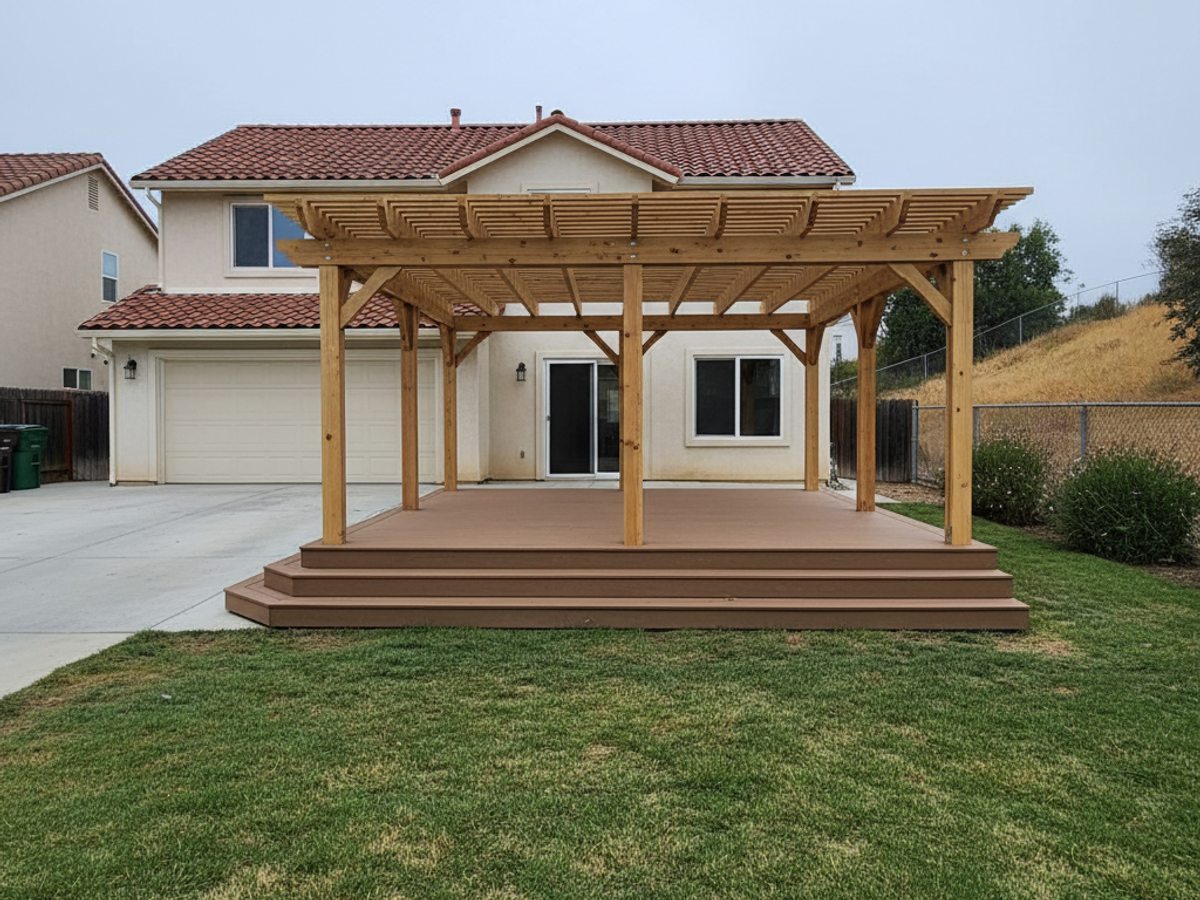
Placerville sits in the Sierra foothills, and that changes more about a deck project than most homeowners expect. The ground isn't flat, the soil isn't simple clay like you'd find in the valley, and the fire season here isn't something you can ignore when picking decking material. Before you sign a contract or pull a permit, there are some things worth looking at yourself, or at least asking about.
What's actually under your lot
A lot of Placerville and El Dorado County soil is decomposed granite, often called DG. It drains fast, which is good, but it's also loose and can shift under footings if it's not compacted right. In older parts of town, and especially down toward Diamond Springs or along the creek drainages, you'll hit pockets of clay mixed in with the granite, and that soil swells when it's wet and shrinks when it dries out. A footing that sits on a transition between the two can settle unevenly over a few years. That's one reason footings here typically go 12 to 18 inches deep with a poured concrete pad, not just a few bags of quick-set dumped in a hole. If your lot has a mix of soil types, it's worth having whoever digs the footings actually look at what comes out of the hole, not just assume it's uniform.
How much slope you're building on
Plenty of lots in this area aren't flat, especially up toward Cedar Ravine, Smith Flat, or the hillside streets off Highway 49. A deck on a steep lot usually means taller posts, which means more lateral bracing, and it often means engineered footings instead of the standard spread footing you'd use on a level yard. If your deck is going to stand more than about 6 feet off grade at any point, ask whether the design calls for diagonal bracing or a moment frame at the posts. This is also where a lot of cost surprises happen, because a sloped lot can turn a straightforward deck into something closer to a small retaining wall project.
The fire rules you can't design around
El Dorado County is a wildland-urban interface zone, and the state has been tightening defensible space rules. Within 5 feet of the house, new regulations push toward ember-resistant construction, which affects what decking material is allowed right up against the structure. Composite that's rated for ignition resistance, or noncombustible materials, are increasingly the expectation in that zone, even if the rest of the deck further out uses standard wood or composite boards. If your builder isn't asking about defensible space zoning on your property, ask them about it yourself. This isn't optional in a fire-prone county, and it's going to matter more over the next few years as enforcement catches up to the code.
Permits, setbacks, and the property line
El Dorado County Building Services handles permits for deck construction outside the city limits, and the City of Placerville handles its own within city boundaries. Either way, a deck over a certain height or square footage typically needs a permit, with inspections at the footing stage and again at framing, before any decking boards go down. Setbacks from the property line are usually in the 5 to 10 foot range depending on your zoning, but older lots platted during the Gold Rush era sometimes have irregular boundaries that don't match a modern survey. If your deck is going anywhere near a side or rear property line, it's worth the cost of a survey rather than guessing from an old fence line. HOAs aren't universal here the way they are in some of the newer subdivisions out toward El Dorado Hills, but if you're in one of those planned communities, check the architectural guidelines before you finalize a design, because railing style and decking color are sometimes restricted.
What's already in the ground
Before any digging starts, get utility lines marked. This matters more on older properties where a prior owner ran a gas line or irrigation pipe without recording it anywhere. Call 811 before footings get dug, not after. On a lot with mature oaks, which is most of Placerville, also check how close any footing will be to root systems big enough to matter, because cutting through a major root can stress or kill a tree you didn't mean to touch.
If you're repairing or resurfacing instead of building new
A lot of the decks going up for repair work in this area were built in the 1990s and early 2000s using pressure-treated pine framing, sometimes undersized for current span tables. Before resurfacing with new boards, check the ledger board attachment to the house. Older decks were often lag-bolted into the rim joist without flashing, and that's a common spot for rot, especially where the deck gets shaded and stays damp into spring. Push a screwdriver into the ledger and the end of a few joists near the house. If it sinks in easily, that's not a cosmetic fix, that's structural, and no amount of new decking on top solves it.
Snow load, sun exposure, and timing
Placerville gets real winter weather, with occasional snow at higher elevations in the foothills between December and February, so framing needs to account for snow load, not just the weight of people and furniture. On the other end of the year, summer temperatures regularly hit the 90s in July and August, and that heat matters for finishing work. Stain and sealant applied in full afternoon sun can flash-dry and fail to penetrate the wood properly, so early morning or evening application works better in peak summer. If concrete footings are part of the job, give them at least 48 hours before loading any weight onto the posts, longer if the weather's cold enough to slow the cure.
None of this is complicated once you know to look for it, but it's the kind of thing that gets skipped when a job is priced and scheduled fast. If you want someone local to walk your lot and tell you straight what the soil, slope, and fire zone mean for your specific property, that's the kind of conversation worth having before any wood gets cut. You can see more about our deck builder work around Placerville and the surrounding towns.