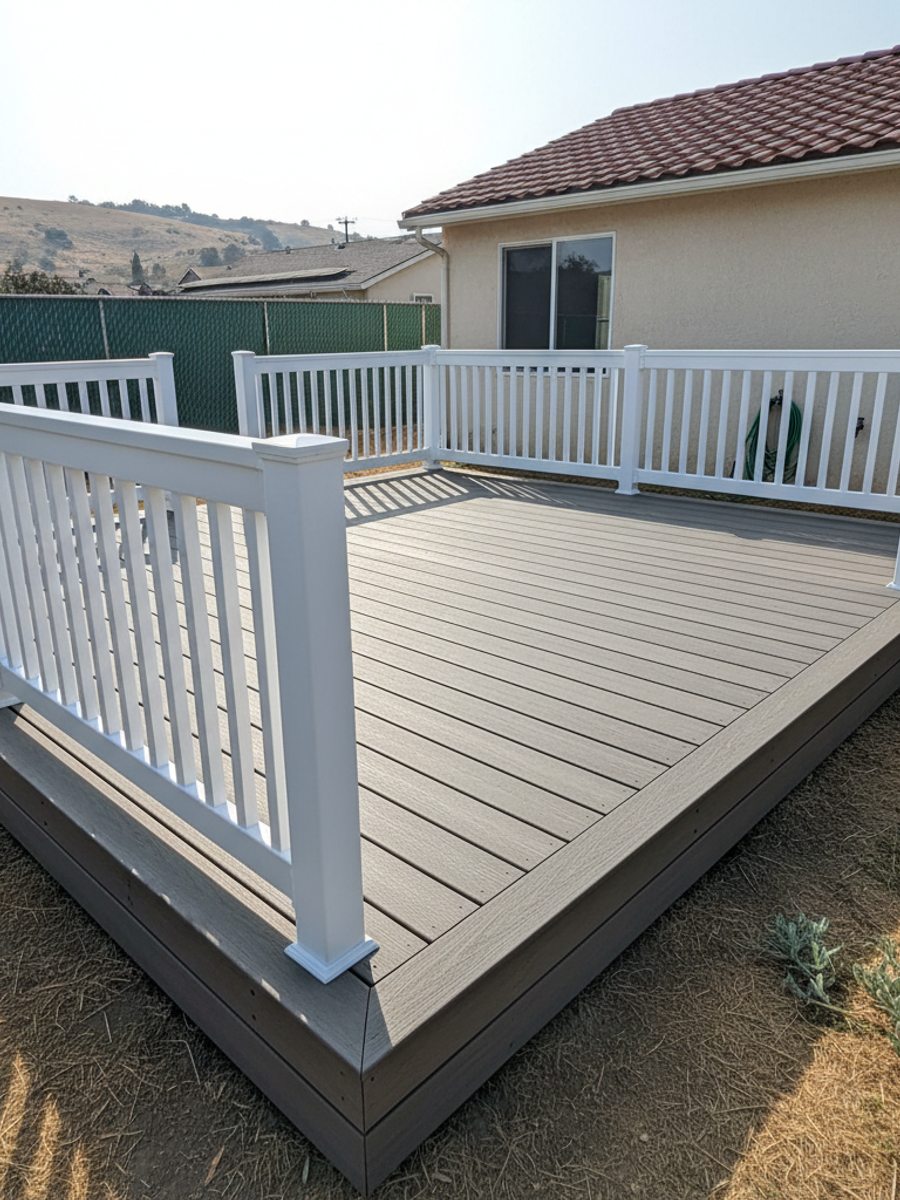
A deck is a structure hanging off your house, usually attached at the ledger board with lag screws or through-bolts into the rim joist. If that connection fails, or the footings settle, people get hurt. That's the frame you should use when you're picking a builder, not the color of the composite boards in the brochure.
Placerville sits in the Sierra foothills at around 1,800 feet, and the ground under most lots here is decomposed granite, sometimes with clay pockets where old fill was brought in. Decomposed granite drains well, which is good, but it also means footing holes can cave in on the sides if a crew isn't careful, and it means hitting bedrock a foot or two down isn't unusual on the steeper lots off Cedar Ravine or up toward Smith Flat. A builder who's worked here knows to check for rock before they quote a standard 18-inch footing depth, because sometimes you're coring into granite and sometimes you're hand-digging through loose decomposed rock that wants to slough back in.
What the climate here actually does to a deck
Summers are hot and dry, June through September, with wildfire season running roughly the same months. Winters bring freeze-thaw cycles, not brutal ones, but enough that water sitting in a joist bay or behind unflashed ledger board will find a crack and widen it over a few seasons. If you're up toward Pollock Pines or Camino, add real snow load to that list, and your builder needs to be sizing joists and beams for it rather than using flatland span tables.
This is also State Responsibility Area territory for fire, and a lot of Placerville is in a wildland-urban interface zone under Chapter 7A of the state building code. That matters for decks specifically. If your home falls under those requirements, the decking material attached to the house may need to be ignition-resistant, and there are rules about clearance underneath the deck, usually keeping combustible material away from the ground-level gap or requiring it to be enclosed. A builder who doesn't bring this up on a house near the tree line hasn't done a deck here before, or isn't paying attention.
Permits and inspections, and why skipping them costs you later
El Dorado County issues the building permit for most deck work outside city limits, and the City of Placerville handles it for lots inside the city boundary. Either way, a deck attached to the house and more than about 30 inches off grade is going to need a permit, and the inspector is going to want to see the footings before they're poured, the framing and ledger attachment before decking goes down, and often the railing height and baluster spacing at final. On older streets downtown, where houses date back to the Gold Rush era or the early 1900s, there's a decent chance the existing structure has no permit history at all for a deck that's already there, which means a repair or a tie-in sometimes turns into a full rebuild once the inspector sees what's underneath. On newer subdivisions built in the 1990s and 2000s further out toward the Highway 50 corridor, the ground is more predictable and there's often an HOA with its own design approval on top of the county permit, so budget time for that step too.
A contractor who tells you permits aren't necessary for your project, without asking your elevation, your square footage, or whether it's attached to the house, is guessing. Get that in writing before you sign anything.
What a real bid looks like versus a lowball
A bid that's thousands less than the others usually skipped something, and it's rarely the decking material, it's usually the framing. Watch for a bid that doesn't specify footing size and depth, joist spacing, or whether the ledger is through-bolted or just lag-screwed into the rim joist. 16 inches on center is standard joist spacing for most residential decking, tighter for some composite products that need more support, and a bid that just says "framing per code" without a number isn't telling you anything.
- Ask what size the footings are and how deep, and whether that changes if they hit granite.
- Ask if the ledger will be flashed with metal flashing and self-adhered membrane, not just caulked. Caulk fails in five years. Flashing doesn't.
- Ask what fasteners they're using for the decking itself, and whether they're rated for the wood or composite you're choosing.
- Ask for the county permit to be pulled in their name, not yours, so they carry the liability for the inspection passing.
Materials, and what they actually cost you over time
Pressure-treated wood decking is the cheapest to install and the most work to keep up. Plan on stripping and re-staining every 2 to 3 years if it's getting real sun exposure, which most south and west-facing decks here get plenty of. Composite decking costs more up front, usually carries a 25 to 30 year warranty against fading and staining, and doesn't need sealing, but it does expand and contract more with our summer heat swings than people expect, so the gaps between boards and the fastening system matter more than they do with wood. Cedar splits the difference, looks good, but is softer and dents more easily than people think.
None of this matters if the frame underneath is undersized or the footings aren't bearing on solid ground. A beautiful composite deck on a shaky frame is still a shaky frame.
The walk-away signs
Walk away if a contractor won't give you a written bid broken down by materials and labor. Walk away if they can't tell you their license number or won't show proof of insurance. Walk away if they want the whole payment up front before any lumber is delivered. And walk away if they brush off a question about permits or fire code as red tape that doesn't apply to you, because in this county, on most lots, it does.
A deck builder who's actually worked the foothills will talk about your specific lot before they talk about pricing. They'll ask about slope, tree cover, and whether you've got granite close to the surface, because all of that changes how the footings get dug and how long the job takes. If you want to see how we handle that kind of site work, our Omega Deck Solutions page has more on the framing and structural side of what we do around Placerville.